Engineering
The Invisible Machine
Why the part nobody looks at is the part that actually works
Why the part nobody looks at is the part that actually works
In early 2026, Anthropic shipped a file it did not mean to ship, and for a few days the source code of Claude Code sat in the open. The internet did what the internet does. It went looking for the fun parts. It found a hidden Tamagotchi, a dream mode, an undercover mode, and it wrote ten thousand posts about the mascots before the lawyers arrived.
Almost nobody read the rest. The rest was the point.
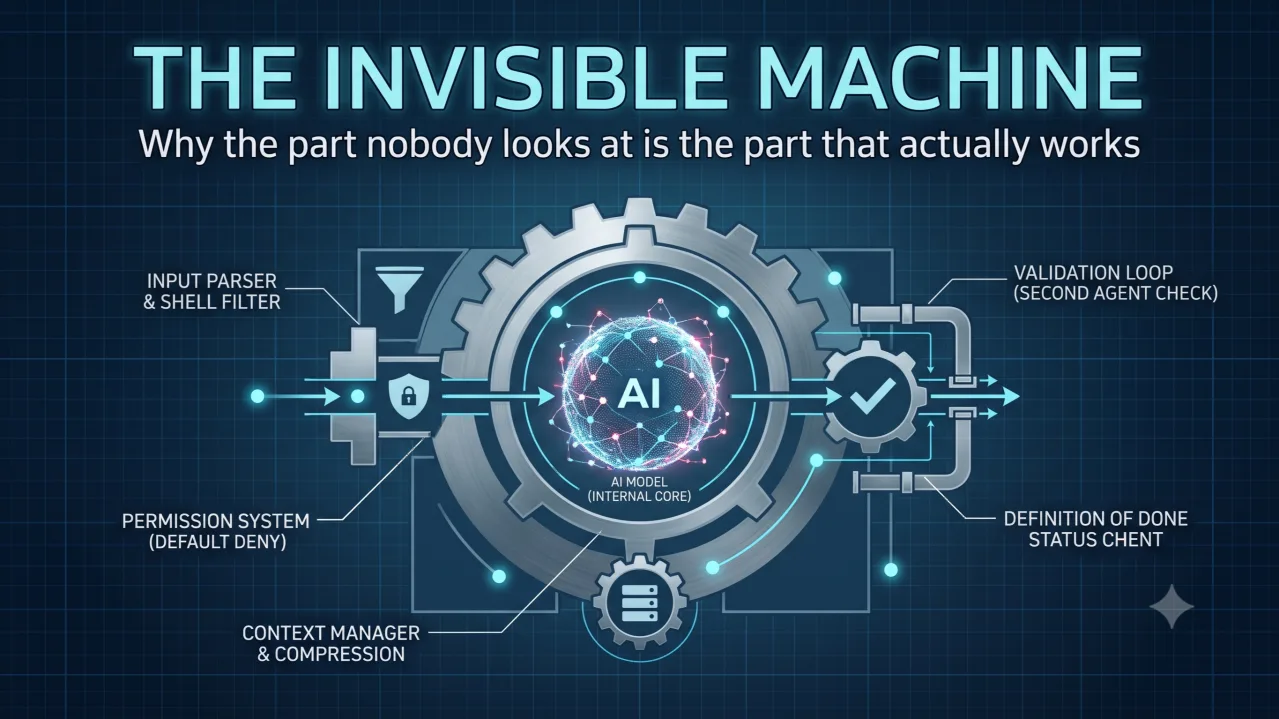
Underneath the toys was half a million lines of deeply unglamorous engineering; messy in places, full of internal security trade-offs, but clear in its structural intent. A parser that inspects every shell command and refuses anything it does not fully understand. A permission system that assumes the worst by default. A context manager that quietly compresses a long conversation so the model never drowns in its own history. None of it was clever the way a demo is clever. All of it was the reason the thing worked.
Here is the principle worth taking from the wreckage. The model is the part you cannot control and cannot claim. It arrives from somewhere else, it will be replaced inside a year, and every competitor can rent the same one by Tuesday. The harness is the part you build. The scaffolding around the model, what it is allowed to see, what it is allowed to do, and how you decide it has finished, is where the actual engineering lives. We stare at the model because the model is the genius in the room. We should be watching the machine we put around it.
Consider what a serious harness does, none of it exciting. It treats context as a scarce resource and feeds the model the smallest set of facts that will do the job, because a model buried in its own history gets measurably worse, not better. It fails closed, so an instruction it cannot parse is refused instead of run. And it defines "done" in a way the model cannot talk its way around. The strongest pattern to emerge in 2026 is almost comically strict. Every success criterion starts marked false, and the agent may not flip it to true without producing evidence that a second agent can check. That second agent cannot edit anything and never saw the work being done. It grades from a clean desk. The model proposes. The harness disposes.
Notice that none of this gets easier when the model gets smarter. A better model inside a sloppy harness just produces confident nonsense at higher speed. The upgrade everyone is waiting for, the release that finally makes the agent reliable, is not coming from the model. Reliability was never a property of the model. It is a property of the system, and the system is yours.
This should be the most encouraging thing an engineering leader hears all year. You cannot make the model smarter. You can make the harness better tonight, with the team you already have. And unlike the model, the harness compounds. The permission rules you write, the evaluation loop you build, the definition of done you enforce, all of it survives the next model release and makes that release worth more. Buying the newest model is a transaction anyone can copy. Building the machine around it is a discipline, and discipline is the only part of this that turns into a moat.
So stop waiting for the model to rescue you. It is already good enough for most of what you need. What is not yet good enough is the machine you have built around it, and that machine has always been yours to build.
A quick reality check on implementation vs. intent. Critics who analyzed the raw leaked codebase rightly pointed out plenty of rushed React code, hacky shortcuts, and security gaps in the prototype itself. They're not wrong, leaked internal tools are rarely polished, and building a secure harness is notoriously hard. But the take-away isn't that Anthropic's initial implementation was perfect; it's that the harness is the actual battleground where modern software engineering happens.