Engineering
The Sophistication Trap
Why more agents feel smarter and quietly build worse
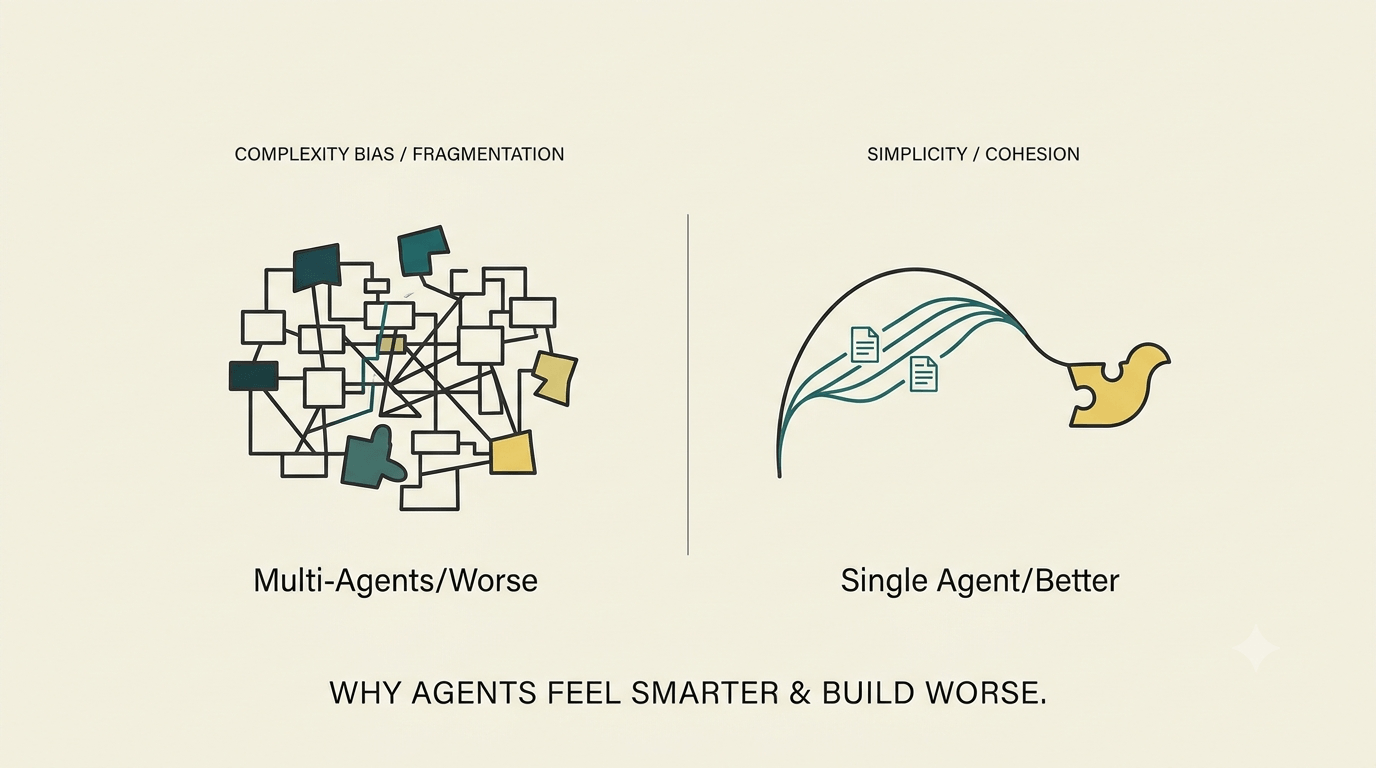
In June 2025, inside a single day, two of the most respected teams in the field published essays with opposite titles. On the 12th, Cognition, the company behind the Devin coding agent, posted "Don't Build Multi-Agents." On the 13th, Anthropic posted "How We Built Our Multi-Agent Research System." Same week, same audience, contradictory instructions from people who all knew exactly what they were talking about.
The reader's temptation is to decide one of them was wrong. Neither was. The space between the two titles is the most useful thing an engineer can carry into 2026.
Cognition's case was concrete. Give one task to several agents at once and each makes a hundred small implicit decisions no one else sees. Their example was a clone of Flappy Bird. Split the work across subagents and you get a bird in one visual style and a background in another, assembled into something no single mind would have designed. Not because any agent failed. Because each filled the gaps in the instructions differently, and the gaps stayed invisible until the pieces were bolted together.
We build multi-agent systems for the same reason we build tall org charts. Sophistication feels like progress. A diagram with one box is a script. A diagram with nine boxes and arrows is an architecture, and architecture is what serious people are supposed to produce. So we draw the nine boxes. The move is satisfying and expensive, because it smuggles in an assumption we would never say out loud: that context travels between agents as cleanly as it travels inside one. It does not. Every handoff is a game of telephone. What one agent knew, the next only half receives.
This is complexity bias in an engineering costume. Handed a hard problem, we reach for the elaborate solution over the plain one, because the elaborate one flatters us and the plain one embarrasses us. A single agent, thinking one step at a time in one unbroken thread, sounds primitive. It also, Cognition found, gets you surprisingly far. The primitive thing works and the sophisticated thing conflicts with itself.
Now pick up the other post again, because Anthropic's researchers were also right. In their domain, many agents did beat one. The reconciliation arrived over the following year and it is worth memorizing in five words: reading parallelizes, writing fragments. Send five agents to read five documents and return what they found, and you get five times the throughput with no conflict, because nobody is making a decision that has to agree with anyone else's. Send five agents to write five parts of one program, and they will quietly disagree about everything the spec left unsaid. By 2026 the pattern that survived contact with production was narrow and specific. One orchestrator holds the whole context. It dispatches short-lived, read-only helpers that come back with compressed findings and no authority. The orchestrator decides. The helpers only fetch.
If you lead engineers, the trap has your name on it, because you are the one who will be shown the impressive diagram and asked to bless it. The nine boxes will look like foresight. The instinct in the room will be that anyone who ships a single-threaded agent simply wasn't ambitious enough. Resist all of it. The question is never how sophisticated the system is. The question is whether the work still fits in one head at the moment it matters, and whether the final diff is something a human can actually sit down and review. An architecture you cannot review is not an architecture. It is a hope with boxes drawn around it.
The elaborate design announces how clever the designer is. The plain one merely works. Choose the one that works, and let someone else keep the diagram.